
An Octopus Looked in a Mirror and Found Its Lunch
The News
At a lab at Dartmouth College, scientists discovered something amazing. Three California two-spot octopuses learned to use a mirror to find food hidden behind them. They got it right about 73 times out of every 100 tries! This is the first time any squishy, no-bones animal has ever been shown to do this — a skill once thought to belong only to a few clever mammals and birds.
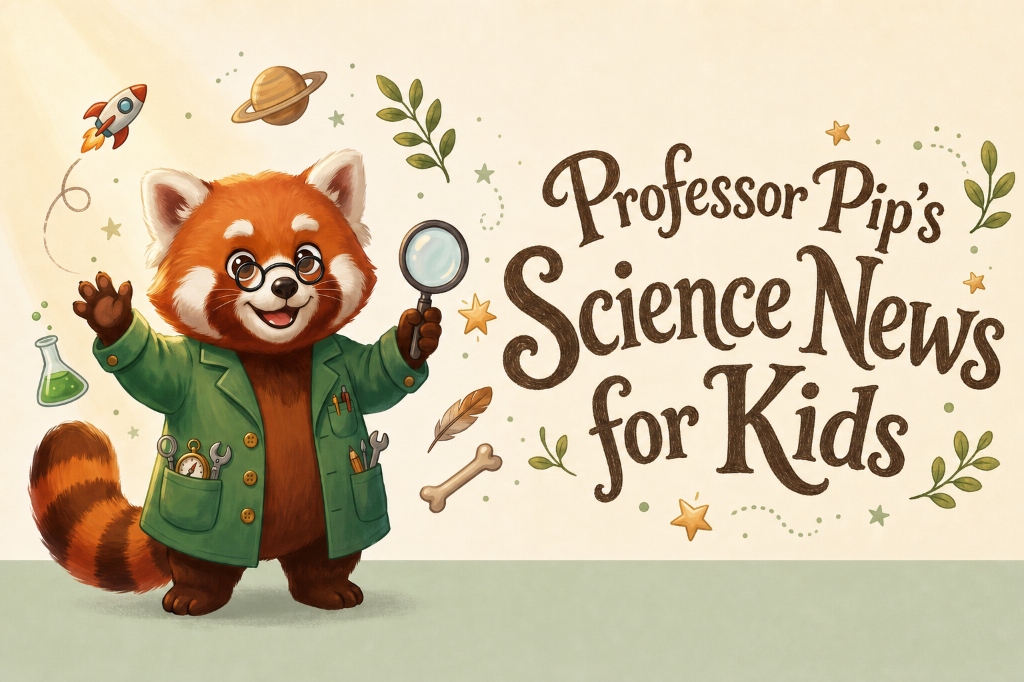
Professor Pip's cozy lab smelled like seawater and warm wood. He patted his green coat pockets, fished out a small round silver mirror, and held it up. "Aha! Just the thing."
Mia, Leo, and their friend Asha leaned over a glass tank where a curious purplish octopus named Wiggles peeked out from behind a rock, one wide eye blinking.
"Today," said Pip, his tail flicking with excitement, "we're going to learn that an octopus can do something that surprised even the smartest scientists!"
"Octopuses are smart?" Asha asked, pressing her nose to the glass.
"Oh my whiskers, yes!" said Pip. "But here's the question: can a wiggly, squishy creature with no bones use a mirror the way you do? To see something it can't see directly?"
He held the mirror up to his own face and waggled his ears. The kids giggled. Then he turned the mirror toward Mia. "Mia, close your eyes. Now — what's behind you?"
Mia opened her eyes and looked into the mirror. "Oh! I see Leo making a funny face!" Leo froze, caught.
"Exactly!" Pip cheered. "Your eyes don't bend around corners. But light bounces. When light hits the mirror, it bounces straight back to your eyes — like a ball off a wall. BOING! Your brain figures out: that thing must be behind me."
He pointed at Wiggles. "Now here's the curious part. Scientists in a lab put a tiny shrimp behind the octopus, where it couldn't see directly. But they placed a mirror in front. Most animals would just stare at the mirror, confused. Wiggles' cousins…"
Pip leaned in dramatically. "…turned around. They figured out the shrimp was real and behind them. They navigated to find it!"
"Whoa," whispered Leo. "Like when I see a ball roll behind the couch — I know to look behind the couch, I don't go inside the TV."
"Precisely!" Pip clapped his paws. "That kind of thinking is called spatial reasoning. It means an animal builds a little map inside its head."
Pip looked at Wiggles thoughtfully. "Here is what makes this so curiouser: the last cousin you and an octopus share was a tiny worm, about 400 million years ago. And yet — somehow — both of us learned the same trick."
He handed each child a small mirror. "Now you try. See if you can pass a snack to someone behind you using only the reflection. No peeking!"
Spark a Conversation
- If your pet looked in a mirror, do you think it knows it's looking at itself? How could you find out?
- Octopuses don't have any bones. What other surprising things can they do that humans can't?
- Where else do you use mirrors in real life — at home, in cars, in the bathroom? Why are they there?