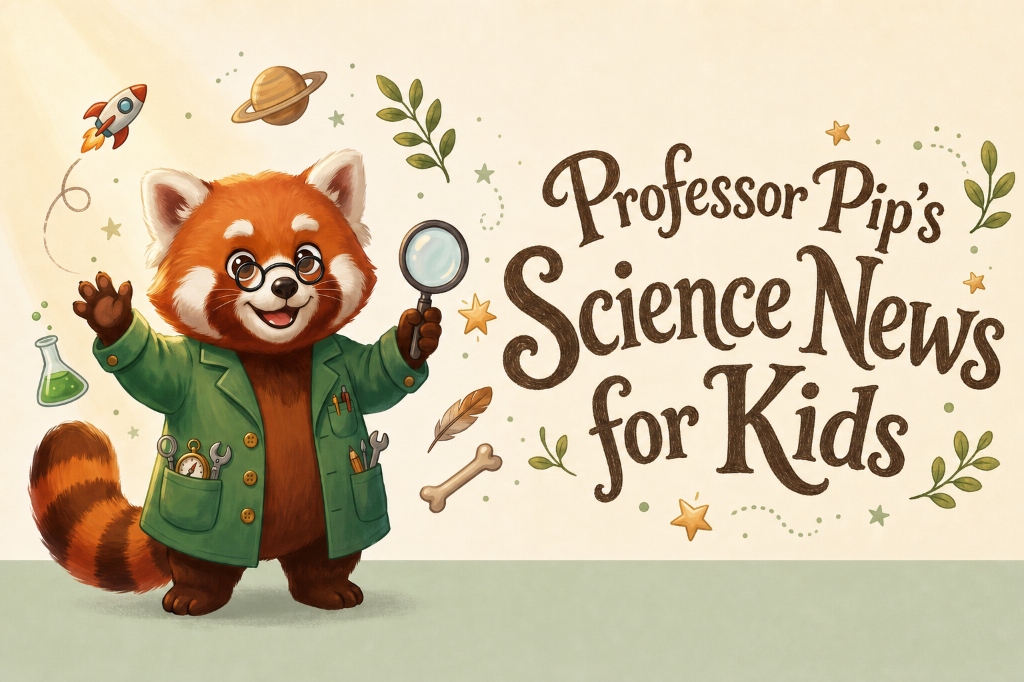
Professor Pip's Science Discovery Banner
Published June 14, 2026

Science for Kids — June 14, 2026: Names, Footprints & a Hidden Moon

A Parrot Might Ac... • Tiny Crawlers Wal... • The Moon You Can'...

A Parrot Might Actually Know Your Name

A Parrot Might Actually Know Your Name
The News: Scientists at the University of Northern Colorado and the University of Pittsburgh studied recordings of more than 889 pet parrots — and found strong clues that parrots aren't just copying sounds. Some birds appear to use specific names for specific people, animals, and even other parrots. A few even say their own name when they want attention.
A Story from Professor Pip's Science Discovery

Professor Pip adjusted his slightly crooked spectacles and patted the pockets of his green lab coat. "Aha! Just what I need." Out came his pocket notebook, a pencil, and a small handful of paper tags tied with string.

On a wooden perch beside him sat a vivid green-and-red parrot named Acorn, ruffling her feathers in the warm afternoon light.

"Today," Pip announced, his bushy tail giving an excited swish, "we're going to learn how a tiny brain can carry names."

"Like my name?" asked Mia.

"Precisely like yours!" said Pip. He pinned a paper tag onto a jar. The tag read Acorn. He pinned another onto a brass bell — Bell. And a third onto Mia's chair — Mia.

"What's a name, really?" he asked. "It's a sound that points to one particular thing. Not all jars — this jar. Not any kid — you."

Pip turned to the perch. "Acorn, hello." The parrot tilted her head. "BELL!" she squawked. Pip held up the bell. The children gasped.

"She's not just copying," Pip whispered. "She's labeling. Scientists in Colorado just listened to almost nine hundred pet parrots — that's a LOT of squawking — and they found something amazing. Many of those birds used special sounds for special friends. Sometimes a parrot would even say a name when that friend wasn't there. Like saying 'Mom?' when Mom's at work."

"Oh!" said Leo. "Like when I call for my dog and he isn't in the room yet!"

"Exactly right!" Pip beamed. "That's called referential communication. A grown-up phrase for: making a sound that points to one specific somebody. Lots of animals make sounds. But using a name? That's a fancy trick."

"Some parrots even use their own name to grab attention," he added, paws clapping. "Imagine if you walked into the kitchen and just announced, 'LEO! LEO! Snack please!'"

Leo giggled so hard he tipped sideways.

Pip looked at Acorn quietly for a moment. "Names are little gifts we give each other. They say, 'I see you. You're not just anyone. You're you.' And it turns out — some birds might be giving each other those gifts too."

He handed Mia and Leo each a paper tag and a pencil. "Now you try. Pick something in your house tonight. Give it a name. Use that name for three days. See what happens."

Spark a Conversation

  • If a parrot is calling a name out loud, how could we tell it's really a name and not just a copied sound?
  • What's the difference between calling someone by their name and just saying "hey"?
  • Do any other animals you know seem to call each other? Dogs? Whales? Cats?

Tiny Crawlers Walked the Land 460 Million Years Ago

Tiny Crawlers Walked the Land 460 Million Years Ago
The News: Scientists at Virginia Tech just finished building the first complete family tree of every kind of millipede alive today. Using DNA from 82 species and 29 fossils, they figured out that millipedes were crawling around on land about 460 million years ago — that's 80 million years before any animal with a backbone took its first step out of the water.
A Story from Professor Pip's Science Discovery

Professor Pip pushed aside a curtain of ferns and dropped to his knees on the damp forest floor. "Aha! Right where I left it." He pulled out his big round magnifying glass and pointed.

Curled in the leaf litter was a tiny creature with dozens of little legs, no longer than Pip's thumb.

"Friends," said Pip, his spectacles slipping down his nose, "say hello to a millipede. And then say a much, much bigger hello — because their family is older than just about anything walking on this planet."

"Older than dinosaurs?" asked Leo, mouth dropping open.

"OH my whiskers, yes." Pip's tail swished. "Older than dinosaurs. Older than frogs. Older than any animal with a backbone that crawled out of the water. Scientists in Virginia just finished the most enormous millipede family puzzle ever made, and the answer is — millipedes were tromping around 460 million years ago."

"460 MILLION?" Mia gasped.

"Let me show you what that means." Pip pulled a brown leaf from his pocket. "Pretend this leaf is dead. Pretend it just fell." He set it on a smooth rock. "Now picture our millipede friend. What's their job?"

"Eat it?" Leo guessed.

"PRECISELY!" Pip clapped. "Munch, munch, munch. Tiny pieces. Then teeny crumbs. Then — and this is the wonderful part — the crumbs become dirt. Good rich dirt that other plants can grow from."

He winked. "That's called being a detritivore. A grown-up word that means: someone who eats dead stuff to recycle it. Millipedes are the world's oldest recyclers. Scientists call them ecosystem engineers — little workers building healthy soil for everyone else."

"Like the soil for OUR garden!" said Mia.

"For every garden, ever, anywhere," Pip nodded. "And here's the most amazing part. Back then — 460 million years ago — there were no trees yet. No leaves. No flowers. Millipedes ate decaying mosses and ancient muck. They were the very first land cleaners."

He looked up at the trees swaying above. "Every forest you've ever seen started with creatures like this one quietly recycling the world."

"What do they recycle if there's no leaves to eat?" Leo asked.

"They eat whatever bits of life have finished living," Pip said softly. "Today, that's leaves. Back then, slime and moss. The job is the same."

He carefully set the millipede back under a fern. "Tonight, when you take a bite of a vegetable from anyone's garden, give a little thank-you to the millipedes. The soil it grew in had help from a family 460 million years old."

Spark a Conversation

  • If millipedes have been around for 460 million years, what does that tell us about what makes a good "job" in nature?
  • What would happen to forests if there were no millipedes, beetles, worms, or other recyclers?
  • Can you think of any "recyclers" in your house — animals or even tools — that turn old stuff into new stuff?

The Moon You Can't See — But the Ocean Sure Can

The Moon You Can't See — But the Ocean Sure Can
The News: This weekend — June 14 through June 16 — Earth is passing through a super new Moon . The Moon is at its closest point to Earth all year (about 357,218 km away) AND it's in its dark "new" phase, so you can't see it. But that hidden Moon is still doing something powerful: pulling extra hard on the ocean, making tides a little higher and lower than usual.
A Story from Professor Pip's Science Discovery

Professor Pip stood at the top of a soft, grassy hill, his lab coat flapping gently in the night breeze. Above him, the sky was the deepest blue-black, freckled with more stars than the children had ever seen.

"Now this," he whispered, pulling out his small brass telescope, "is what we call a super new Moon sky. And it's only going to last a few nights."

Mia squinted up. "Where's the Moon?"

"That's the trick!" Pip's whiskers twitched into a grin. "You can't see it. It's there — closer than it'll be all year, just 357,000-some kilometers away — but it's standing right between us and the Sun. The sunny side is pointed away from us. So to our eyes, the Moon vanishes."

"That's so weird," said Leo.

"And here's what's wonderful." Pip pulled a long piece of rope from his coat pocket. He handed one end to Mia, the other to Leo. "Mia, you're the Moon. Leo, you're the Sun. I'm Earth, with all my oceans. Now both of you — gently — pull on the rope."

Mia tugged. Leo tugged. Pip's coat swayed in the middle.

"See how my coat lifts on both sides? When the Sun and the Moon line up in a row, they pull together. Their pulls add up. And that pull bulges the oceans — making tides higher when they're high, and lower when they're low. We call this a spring tide."

"But the water doesn't fly to the Moon," Mia checked.

"Oh no, just a little tug," Pip laughed. "A few inches. But all across the ocean, a few inches of extra water adds up to a LOT. When the Moon is at its closest point — its perigee — that pull gets just a tiny bit stronger. And when that happens during a new Moon, scientists call it a super new Moon."

"Like a celestial tug-of-war!" said Leo.

"Exactly right!" Pip beamed. "And here's the bonus gift. Because the Moon is hidden and the sky is the darkest it'll be all month — tonight is the perfect stargazing night. The Milky Way. Tiny faint stars no one usually sees. Maybe a shooting star or two."

He held the telescope up. The children took turns peering through. A pale silver streak of meteor zipped overhead.

"Curiouser and curiouser," Pip said softly, looking up. "Even when something hides itself away — it can still be pulling at the whole world."

He handed each of them a tiny pebble. "Tonight, drop this in a glass of water. Watch how something so small can move so much. Then go outside, look up, and remember — the biggest pull on the ocean right now is invisible."

Spark a Conversation

  • If the Moon's pull on the ocean is invisible, what's another invisible thing in your day that has a big effect on you?
  • Why do you think the new Moon happens about once a month?
  • What might be different at the beach today versus on a regular weekend?

Curiouser and curiouser. See you Tuesday, my fellow scientists.
— Professor Pip 🥼 & the Daily Science for Kids team.